AI Glasses Market Trends in 2026
Smart glasses attract a lot of prediction and very little certainty. Rather than repeat growth numbers that different analysts disagree on, this piece is about what a distributor can observe on a bench in Shenzhen and reason about for a European shelf: which feature sets actually sell, where the physics and the privacy rules bite, and what to ask a supplier before you commit a purchase order. Where a figure is quoted here it is directional and commonly repeated in the industry, not a precise market size we can defend.
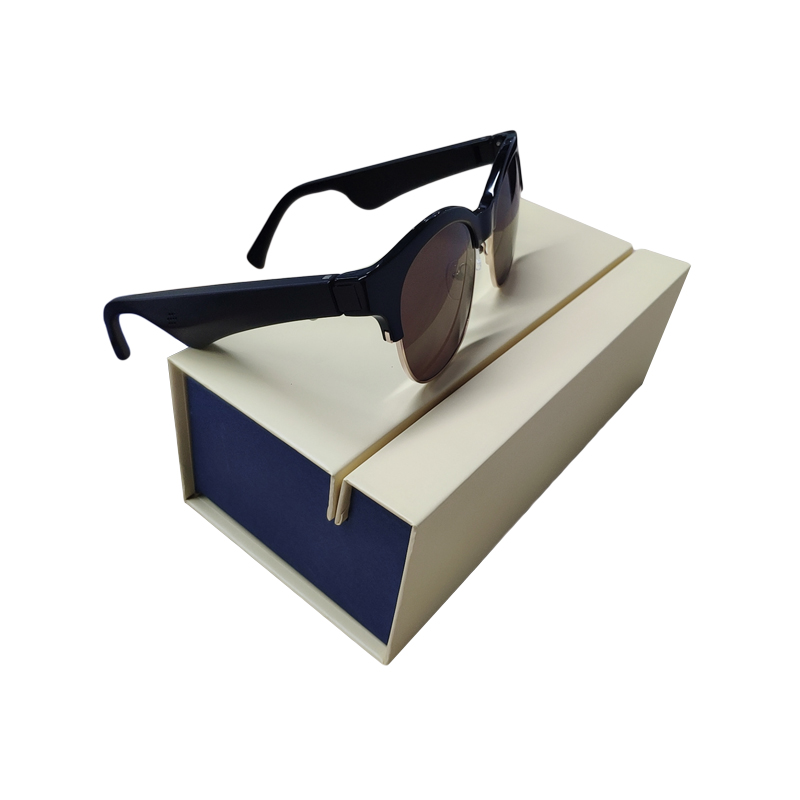
What the category actually looks like now
The honest summary is that the momentum is behind lightweight, ordinary-looking frames that do two things well — open-ear audio and capture — plus an AI assistant bolted on, usually by leaning on a paired phone. Fully independent, all-day AR displays exist but remain a premium, lower-volume niche: cost, brightness and battery keep them off most high-street shelves. So when a retailer asks for “AI glasses” in 2026, they very often mean audio-plus-camera frames with a translation or assistant feature, not a holographic headset.
The features that move units
Open-ear audio
Directional speakers in the temples are the most broadly accepted feature because they solve a real problem — you hear prompts and calls without blocking ambient sound — and they barely change the form factor. It is also the feature with the least resistance from buyers, since there is no camera in play.
The camera
A first-person camera is the second most requested and the most controversial. It is genuinely useful for point-of-view capture and hands-free photos, and it is the feature that most often triggers the privacy conversation covered below.
Real-time translation as the retail hook
Translation is the demo that sells the glasses, because a shop assistant can show it in thirty seconds. Be sober about it: common claims sound impressive, but accuracy degrades with accents, jargon and background noise, and it is typically cloud-assisted. Present it as a strong feature, not a guarantee. If you are going to build a listing around translation, test it on real audio first.
Why battery, heat and wear time cap the pitch
The three constraints that decide whether glasses go back on the shelf are physics, not marketing. Continuous camera recording, on-device AI and a bright display all draw power and produce heat against the temple and behind the ear. A frame that feels fine for a commute may feel warm and short-lived through an afternoon of translation. This is why audio-only or occasional-capture models wear longer than record-everything models, and why you should test real usage, not the headline standby figure.
What to ask your supplier: real battery life under continuous audio-plus-camera use, and the surface temperature after twenty minutes of recording — not the maximum advertised standby time.
Privacy, GDPR and the camera indicator
For EU buyers this is the make-or-break section, and it is a product question, not only a legal one. Two things matter. First, consent visibility: a clear, un-bypassable indicator that recording is happening is what separates a device people tolerate from one that gets complained about. Second, data handling: whether recordings and voice data go to a cloud service, whose terms govern it, and whether the processing region can be set to the EU. Under GDPR the distributor and importer can carry obligations for what data leaves the device, so “we do not touch the data” is not a satisfying answer. None of this is a legal opinion — ask your own adviser — but it explains why hosting-region and indicator questions now come up in almost every European RFQ.
Price-band reality
Retail prices overlap, but the bands below describe the practical tiers we see buyers shop in, and what each one has to be careful about. Treat the ranges as directional.
| Tier | What it includes | Where it wins | Watch-outs |
|---|---|---|---|
| Audio-first frames | Open-ear speakers, mic, basic assistant | Longest wear time, easiest to sell, fewest objections | Thin “smart” story beyond audio |
| Audio + camera | POV photo/video, mic array, translation | The demo that drives retail movement | Heat, storage, the privacy conversation |
| Audio + camera + display | MicroLED or waveguide overlay | Premium positioning | Brightness, cost and battery limit volume |
| Connected AI | Cloud AI and translation with a phone | Feature breadth | Data hosting region, latency, GDPR fit |
What a distributor should ask for
- SDK or API access — can you build a small integration or automate provisioning, or is the app a closed box?
- App store listing — is the companion app on the major stores, in your languages, and who maintains the listing?
- Data hosting region — where is voice and image data processed, and can it be pinned to an EU region?
- Consent indicator behaviour — is the recording light visible, and can it be disabled (it should not be)?
- Certification and lifecycle — CE RED and FCC documentation for the exact revision, plus a realistic firmware-support window.
If a supplier can answer all five concretely, the category stops being a gamble and becomes a normal line extension you can pilot at our standard 500-unit MOQ.
FAQ
- Are smart glasses going to replace phones soon?
- There is no good evidence for that in the current generation. Camera-and-audio glasses work best as a companion to a phone — they lean on it for connectivity and processing. Treat them as an accessory that earns shelf space for a specific use case, not a replacement device.
- Is real-time translation accurate enough to sell on?
- As a retail hook, yes — it is the feature most shoppers remember. But set expectations: accuracy drops with accents, jargon and background noise. Demo a unit on a noisy call before you build a listing around it.
- What do European buyers worry about most?
- Privacy. A visible recording indicator, where the data is hosted, and whether it can sit in an EU region are the questions that decide whether a camera model gets stocked or quietly returned.
- How do I test the category without a big bet?
- Start at the low MOQ for a standard model — 500 units — and evaluate the app, the SDK access and the data-hosting region on that pilot before committing to packaging or a white-label build.