AI Toys for Toddlers: What They Must Refuse to Be Sellable
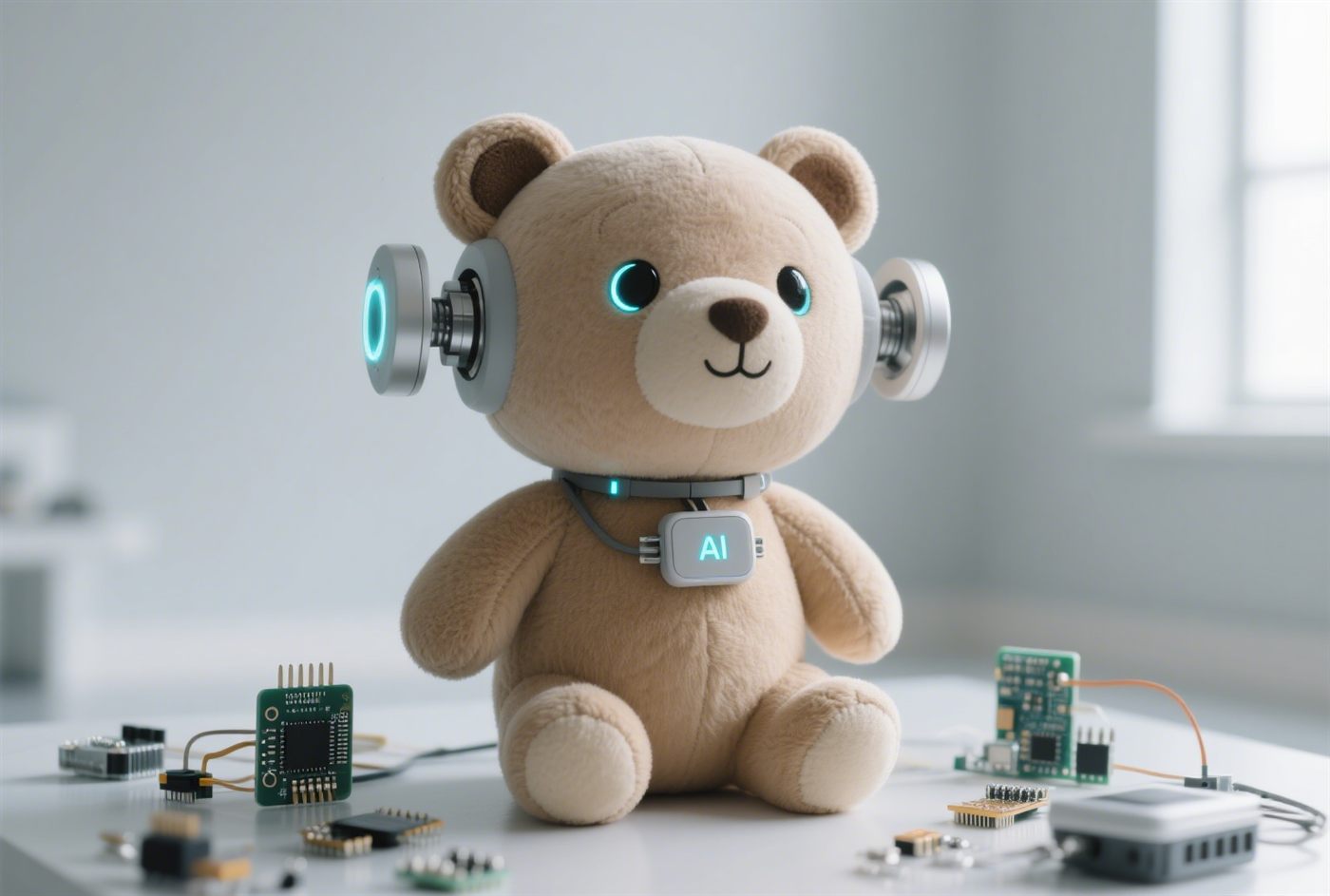
AI toys for toddlers are defined not by what they do, but by what they refuse to do. They must refuse persistent microphone activation, refuse unbounded internet-sourced responses, refuse autonomous data retention beyond 72 hours, and refuse any claim implying developmental diagnosis or health monitoring. These refusals are not engineering trade-offs — they are prerequisites for EN 71-1/-2/-3 and EN 62115 certification, and they anchor every hardware revision booked with an accredited laboratory. WingPhoenix treats them as non-negotiable boundaries, enforced at IQC, IPQC and FQC gates.
Microphone Consent Is Hardware-Locked
The microphone on every E1 AI Learning Robot and K1 AI Companion Robot is physically disconnected from the audio processing chain until the child presses a tactile button. No firmware override, no cloud command, no scheduled wake-word detection is permitted. This design satisfies EN 62115 Clause 10.2 (audio input control) and eliminates the need for GDPR-K-compliant “always-on” consent architecture. The button itself is sized and shaped to prevent accidental activation by under-three motor patterns — verified during EN 71-1 mechanical testing.
Parent App Controls Are Bound to Firmware Limits
The parent app does not grant authority — it reflects constraints already baked into the device. It cannot enable voice recording, extend data retention beyond 72 hours, or unlock uncensored response sets. All settings visible in the app map one-to-one with registers in the device’s secure boot partition. If a setting does not appear in the app, it does not exist in firmware. This prevents post-deployment feature creep and aligns with the how to vet a supplier checklist: ask for the firmware register map, not just the UI flow.
Content Limits Are Pre-Loaded, Not Filtered
There is no real-time content filter. Instead, every model ships with a fixed, audited response corpus — no more than 1,200 phrases — covering only approved topics: animal names, colour recognition, simple counting, weather adjectives and nursery rhymes. Responses are static text-to-speech outputs, never generated. This approach meets EN 62115 Annex G and avoids the regulatory grey zone of LLM-based output for children under three. The AI Learning & Robotics line uses this same corpus architecture across all toddler-grade units.
Data Retention Ends at the Device Edge
No audio snippet, no transcript, no interaction timestamp leaves the device unless explicitly triggered by the parent via the app — and even then, only as a one-time encrypted export. There is no cloud sync, no telemetry pipeline, no anonymised analytics feed. The 72-hour local retention window is enforced by a write-only hardware timer; once exceeded, the buffer overwrites itself without logging. This is confirmed during FQC using the how we build and test protocol, not vendor documentation alone.
What This Product Cannot Do — And Why You Should Say No
This product cannot accept a “GDPR-K compliant” claim without evidence of a full audit trail: source data provenance, human-reviewed intent labels, and third-party validation of the wake-word rejection rate. No WingPhoenix toddler device carries that certification — because no accredited lab currently offers it for this age band. If a supplier asserts otherwise, request their notified body report number and the exact scope of assessment. Without it, the claim is marketing, not compliance. Refer to the MOQ, sampling and lead times page: hardware revisions are certified per build, not per SKU family, and each requires fresh lab booking.
| Decision Point | Required Evidence | Test Gate | Policy Reference |
|---|---|---|---|
| Microphone activation | Hardware schematic showing physical disconnect path | IQC | EN 62115 Clause 10.2 |
| Response corpus scope | Complete phrase list, version-stamped, signed by firmware lead | IPQC | Toy Safety Directive Annex II |
| Local data retention | Firmware register dump showing 72h timer + overwrite logic | FQC | GDPR-K Recital 38 |
| Age grading alignment | Lab report matching packaging label to EN 71-1 mechanical tests | OQC | EN 71-1 Clause 4.2 |
| No health claims | Marketing copy archive showing zero use of “monitor”, “detect”, “assess” | OQC | Toy Safety Directive Article 10 |
| Battery compliance | UN38.3 summary + SDS + Wh rating printed on unit | OQC | UN Manual of Tests and Criteria |
| Skin-contact nickel release | EN 1811 test report for final surface finish | IQC | REACH Annex XVII |
- Verify microphone hardware lock before approving firmware builds
- Require full response corpus listing before lab submission
- Confirm 72-hour retention logic is implemented in silicon, not software
- Check that packaging age grade matches EN 71-1 test report scope
- Reject any marketing material referencing wellness outcomes or developmental metrics
AI toys for toddlers succeed only when their limitations are explicit, auditable and enforced at every stage — from schematic review to OQC stamp. WingPhoenix does not offer “upgradable consent” or “cloud-managed safety”. Instead, we build refusal into the PCB, the firmware and the factory policy. If your next tender requires proof of those boundaries, send us the specification. We will respond with the lab booking confirmation, firmware register map and corpus version — before quoting MOQ or lead time.
Questions buyers ask
Why can’t an AI toy for toddlers just “listen all the time” like adult devices?
Because continuous microphone activation violates EN 71-4 and GDPR-K requirements for children under three. It triggers mandatory audio recording consent — which a toddler cannot give and a parent cannot meaningfully delegate in real time.
How do finance or compliance teams verify that data retention is truly limited?
They require written confirmation from the supplier that no on-device storage exceeds 72 hours of voice snippets, that cloud uploads are opt-in per session, and that firmware logs show no background audio buffering — all testable at FQC.
What happens when a distributor receives a sample that plays unfiltered YouTube-style responses?
The unit fails OQC against EN 62115 Annex G and the Toy Safety Directive’s “age-appropriate content” clause. No revision passes without pre-loaded response sets, hard-coded topic boundaries and no internet-dependent generative output.
What do most suppliers avoid naming outright?
That no current AI toy for toddlers holds a CE-marked “voice assistant” classification — because such classification requires full GDPR-K audit trails, live human review of training data, and third-party validation of intent recognition logic. None exist yet for this age band.
Related: more on ai toys & dolls · buyer guides · customisation tiers